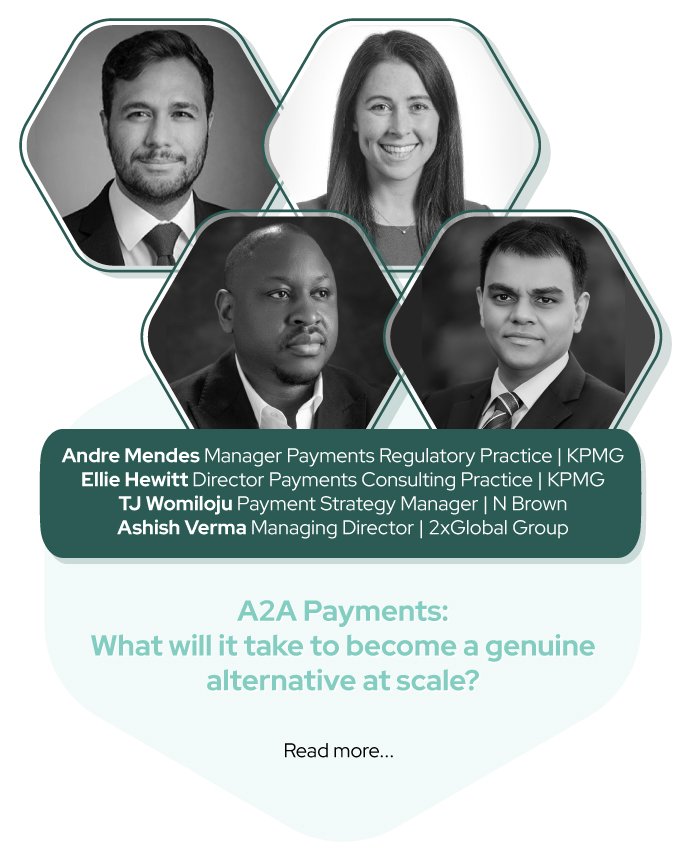


Andre Mendes – BIO:
Andre Mendes is an experienced manager at KPMG’s Payments Regulatory practice. Andre has advised entities from both public and private sectors with the design and response to regulatory frameworks concerning the provision of payment services. His experience includes advising central banks, leading industry bodies and payment service providers in respect of payments regulatory compliance.
Ellie Hewitt – BIO:
Ellie is a Director in KPMG’s Payments Consulting practice. She heads our European payments strategy, commercialisation and product teams, as well as KPMG’s open banking and open finance propositions. Ellie has extensive experience in payments product innovation, strategy, use case design, M&A activity, and running large transformation programmes.
TJ Womiloju – BIO:
TJ Womiloju is a payment and product management leader with deep expertise in payment acceptance, real-time payment systems, and open banking. With extensive experience launching and scaling products across the UK and EMEA, TJ brings strong leadership in financial services and payments strategy, focused on driving growth, adoption, and customer-centric innovation.
Ashish Verma – BIO:
Ashish Verma is Managing Director for the Global Finance and Operations at 2X Global, where he works alongside the Chief Executive on financial strength, operational effectiveness and people strategy. He also sits on the board of the 2X Ignite Private Equity Fund, an impact investment vehicle. An ACA-qualified finance leader with more than fifteen years in senior roles across the UK, Europe, Asia and the Middle East, he was previously Chief Financial Officer for an Asian Conglomerate. He brings a buyer’s perspective to payments: what a rail costs to adopt, where the risk sits, and what has to be true before a finance function changes how it moves money.
Fraud, tokens, passkeys and the race to phase out the card number — and what it means for everyone who still pays by phone.
BIO:
Robert Crutchington is co-founder and CEO of Encoded, a UK payment service provider and orchestration platform delivering secure payment solutions across contact centre and e-commerce channels. A published author on card data security and a recognised voice in UK payments, he leads the company’s strategy, direction and growth.
AI isn’t just helping your customers decide what to buy, it’s starting to buy things for them. As humans get further away from the transaction, is a card, built for in-person transactions, really the best option?
Drawing on GoCardless’s own UK merchant and payer research and our place in the FCA’s AI Live Testing programme, this keynote sets out why account-to-account (A2A) payments, with structured delegation and human-in-the-loop controls, are the infrastructure actually built for this shift, and what “agent ready” should mean for your payment stack.
BIO:
BIO:
Tom is the Director of External Affairs & Public Policy at GoCardless. He leads the organisation’s efforts to understand and shape the future payments environment by listening to merchants’ and ensuring their opinions are heard by policymakers, regulators and other stakeholders in the payments ecosystem.
You don’t need to be loud to stand out. This keynote helps you define your personal brand, uncover what makes you unique, communicate your story with confidence, and build visibility, credibility, and opportunities authentically.
BIO:
Yota Trom is a founder and coach working on the human side of tech. She started as a software engineer, built her career through leadership roles at Yahoo and Amazon, and now works with senior teams and leaders inside companies including OpenAI, Google, Microsoft, Meta, Siemens, and the Bank of England, helping them lead through AI transformation, focusing on the part that’s hardest to get right: the people. Yota holds an MSc in Applied Positive Psychology and is an ICF accredited coach. She also sits on the advisory board of UCL’s School of Management, and serves as a UK representative to the UN Commission on the Status of Women.
Help payments leaders discuss how recent changes in commerce, customer behaviour, payment methods, fraud tactics, AI, and emerging agentic commerce models are affecting — or could soon affect — chargebacks, dispute operations, and revenue recovery.
BIO:
Patrick Dowling is passionate about the future of payments and helping clients navigate the evolving world of chargebacks, fraud, and revenue protection. At Justt, he works with leading enterprise organizations across EMEA to explore how AI and automation are transforming dispute management and operational resilience. Patrick enjoys bringing together industry insights, customer perspectives, and emerging trends to help payments leaders think differently about protecting revenue while creating better customer experiences. Based in London, he is an advocate for innovation, collaboration, and advancing the conversation around the future of commerce and the payments ecosystem.
Innovation and disruption in payments are not new.
But the amount of mature and scaled technology adoption cycles happening all at once right now is unprecedented.
BIO:
Leda is a seasoned fintech executive and former banker, with a career spanning two decades working in transformation and technology functions across a variety of financial services verticals.
She is the author of best-selling book ‘Bankers Like Us: Dispatches from an Industry in Transition’ (Taylor and Francis, 2023) and of the recently released ‘Beyond Resilience: Patterns of Success in Fintech and Digital Transformation’ (Taylor and Francis, 2025).
She a frequent keynote speaker at flagship industry events globally including SIBOS, Money 20/20 and Finovate, as well as specialist regional and corporate events for banks, tech companies, issuers and regulators; and she is the author of the highly acclaimed #LedaWrites column on Fintech Futures.
Leda is a Visiting Professor of Practice for the University of Loughborough London, focusing on fintech and the digital economy.
She works as an external advisor to boards and executive teams for banks, financial institutions and technology companies globally, supporting leadership teams in transition: be it a process of transforming themselves, their business or their software infrastructure. Additionally, Leda works with established technology and younger fintech companies as an external advisor.
Leda is also the Chair of the Board for Bourn AI and recently served as a Non Executive Director for Flagstone (who achieved one of the highest capital raises of its kind in the UK with backing from Estancia Capital). She was a NED at Simply Pay Me (until its acquisition by MyTown Technologies) and she chaired the Board of Geophy (now a Walker and Dunlop company) through its successful exit.
Previously, Leda served as the Chief Client Officer of 10x Banking and the founding CEO of 11:FS Foundry (both in the cloud-native core banking space); she was the Chief Innovation Officer of Qatar National Bank and held a variety of client facing technology innovation and business transformation roles at BNY Mellon.
Leda completed her undergraduate studies at King’s College Cambridge and holds an MSc and PhD from the London School of Economics and Political Science.
Opportunities / challenges merchants want to consider as the strategy is implemented.
Alan Horsfield – BIO:
A Payments Risk and Regulation consultant with experience helping organisations to understand and achieve compliance with payments regulatory requirements. Alan has advised large global Banks, Corporates and fast-growing Fintechs across issues such as SCA, Open Banking, Merchant Acquiring Authorisation and CHAPs compliance.
Michelle Plevey – BIO:
Michelle is the Director of KPMG’s payments regulatory team, providing advice to a wide variety of payment service providers including Banks, Payment Schemes, FinTechs and EMIs. Her expertise includes Strong Customer Authentication, Regulatory Authorisations and Open Banking.
Matt King – BIO:
Global lead for Adyen’s partnership with a major GSI, supporting a team of 12 dedicated ICs and driving growth across EMEA, NA, LATAM, and APAC. I oversee the dedicated resource within the GSI to ensure alignment and maximize success. Part of the team building out strategic partnerships with global system integrators and consultancies. Experience in developing strategic alliances with global consulting firms & GSIs, enterprise selling to retailers/CPGs/B2B/telco/media, exceptional communicational skills and tech ecosystem knowledge in Payments, eCommerce and marketplaces. Helping Adyen develop a global partner program by building strong GTM strategies, education, co-selling techniques and leveraging personal network with global system integrators and top consulting firms.
Robert Crutchington – BIO:
Robert Crutchington is the CEO of Encoded Ltd, where he has spent 25 years shaping the evolution of payment technology. Under his leadership, Encoded has focused on bridging point-of-sale and e-commerce through modern payment orchestration, tokenisation, and seamless omnichannel experiences. Robert is passionate about removing friction from payments and believes the future lies in unified, secure platforms that adapt to how consumers want to pay — wherever commerce happens.
The commercial rollout of Variable Recurring Payments represents the single biggest upgrade to the UK’s payment infrastructure in a generation. Businesses that treat this as a strategic priority today will not only reduce their operational costs but will redefine their relationship with their customers.
Join our session to find out:-
BIO:
As our Open Banking Account Executive at GoCardless, Daniel supports business leaders through the ever changing payments landscape. With 10 years’ experience working with finance teams on cloud technology, Daniel is specialised in corporate and enterprise level sales. His experience includes helping to bring payments and financial document solutions to market, managing multi-departmental deals with board level approval as well as mentoring and coaching for new starters in sales.
Holly Mead – BIO:
Holly Mead is an award-winning journalist who has been writing about investing and personal finance for 15 years. She previously worked for The Times & Sunday Times, where she launched and hosted the paper’s Feel Better About Money Podcast, and has also worked for The Sun, Daily Mail and the investment research company Morningstar. She has won multiple awards for her comment pieces, broadcast work and investing articles and investigations.
Adoption of open banking has been showing steady growth since its inception in 2018, often led by significant regulatory changes. The latest of these is the rollout of commercial Variable Recurring Payments. Variable Recurring Payments (VRPs) will enable recurring payments of differing amounts to be made via open banking.
At present they’re only available in very specific use cases with the commercial rollout coming later this year. But, what does this mean for your business and how you collect recurring payments? Join GoCardless’ panel discussion where we discuss why businesses are looking to implement VRPs. We will also be joined by policy specialists to find out more about current VRP developments and the future potential for the commercial rollout.
Farrel Levenson BIO:
Farrel has nearly a decade of experience building customer-centric products and driving double digit growth across product leadership and strategy roles. Most recently, she has worked across consumer marketplaces and payments products to help established businesses expand beyond their core with new ventures and business lines.
Tom Burton BIO:
Tom is within public affairs, regulatory policy, communications and business advisory professional specialising in the financial services and technology sectors. He is a Payment Systems Regulator (PSR) Panel Member and Board member of the Open Finance Association.
Nick Davey BIO:
Nick joined Open Banking Limited in April 2024, having previously worked at the PSR and the Bank of England, with around half of his career at the Bank involved in payment policy and settlement. Notably, Nick managed the Bank’s Banknote Circulation Scheme, and managed the Payment and Settlement Analysis team where he worked with a number of the interbank payment systems and direct participants in those systems.
The presentation will discuss these developments and illustrate crypto, regulation, greater customer demands, and risk awareness will alter the industry landscape in the next three years.
BIO:
Eliot Heilpern is currently CEO and founder of the Banking and Payments Advisory Group entitled Parthenon Communications. The Company provides advice and solutions on International Payments to the Corporate, FI, and Fintech sectors.
Eliot is a seasoned executive and multi-disciplinary business leader; well experienced at the intersection of payments, relationship banking, risk, partnerships, supporting technologies, and industry regulation.
His professional background is: Senior Banker with regards to Client Relationships and Revenue Generation. Currently, he is an International Payments Consultant to the Payments and Fintech Industry. He maintains a strong understanding of the Financial Eco-System, having spent more than 25 years in the industry in the UK and overseas. His core areas of expertise are: Corporate and FI Banking, Correspondent Banking, Relationship Management, Global Transaction Services, and Cash Management; including supporting KYC and Due Diligence.
Eliot was former UK CEO of a UN/UNICEF affiliated international organisation, and has held various senior positions with several key international banks, and financial entities in the UK, and abroad overseeing; international retail, wholesale and corporate banking, and cards.
How a data-led fraud strategy used geographical insights to boost approval rates and reduce false declines in a challenging US market.
BIO:
I’m a payments and fraud specialist with a background spanning aviation, retail, and e-commerce. I currently lead payments at Heathrow Airport, overseeing end-to-end solutions for Marketplace, parking, rail, and premium services. Before this, I managed global fraud and payments at Dr. Martens, and prior to that, worked in revenue protection at easyJet. I bring a blend of commercial strategy and technical know-how, with a focus on secure, scalable, and customer-centric payment journeys.
Payment systems are wonderful for banks which make money from it, for retailers and other merchants who get more business and save costs, and of course for customers, but ultimately there will be a residual group who want and in many cases need cash. What should the payments industry be doing to ensure that technology facilitates their lives too?
Payment systems are wonderful for banks which make money from it, for retailers and other merchants who get more business and save costs, and of course for customers who can pay more easily and quickly 24/7 if (a) they have latest tech and (b) are happy and (c) able to use it for paying and moving money.
How will the payments industry convert them? Each presents different challenges which I would explore in this presentation. But ultimately there will be a residual group who want and in many cases need cash. What should the payments industry be doing to ensure that technology facilitates their lives too?
BIO:
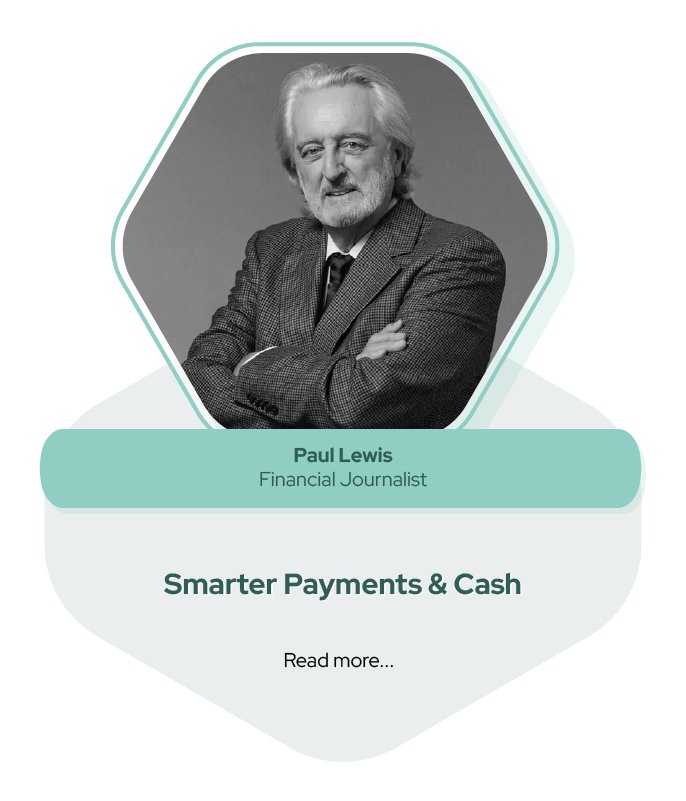
Paul Lewis has been a freelance financial journalist since 1987. He writes extensively on money issues and is a regular guest on BBC TV and Radio programmes.
Paul became established in the public’s eye as a reporter on BBC’s Money Box in the 1990s and, following a three year stint on Radio 5 Live, returned as presenter on Money Box in September 2000.He also regularly appears on other BBC Television programmes such as BBC Breakfast, BBC News Channel, BBC Radio 4 topical shows such as You and Yours, Woman’s Hour and Analysis, as well as BBC Radio 4 news programmes like Today, The World at One and PM.
Focusing on the human behind the payments leader, based on a mix of quantitative survey data collection and qualitative in-depth merchant interviews
BIO:
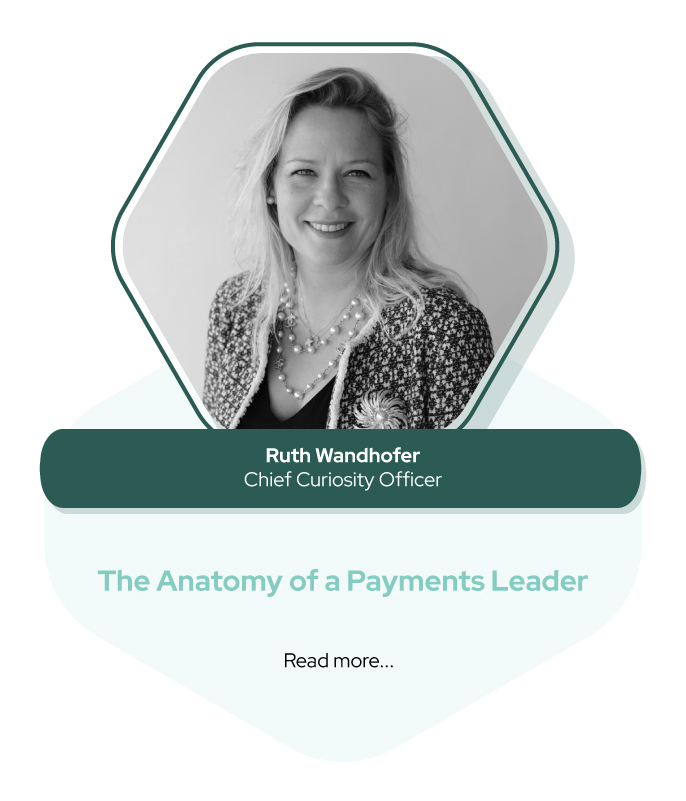
Dr. Ruth Wandhöfer has been instrumental in shaping the future of finance and money during her impressive career over more than 22 years. She operates at the nexus of technology, identity, finance and regulation and advises and speaks to international audiences on the evolution of the digital economy.
As a sought-after keynote speaker, author and recognised global authority on banking, technology and regulation she is a very influential female leader in the Fintech space, promoting the understanding, development and deployment of new business models and technologies for our digital future across payments, financial markets and processes. She advises firms and sits on various boards as non-executive director.
Discuss the key regulatory priorities for firms and regulators – what does the future of payments regulation hold?’ A phenomenal chance to discuss points of view and receive valuable feedback from the PSR, and let us help you by providing insight into the challenges we have seen across the market in terms of regulatory compliance.
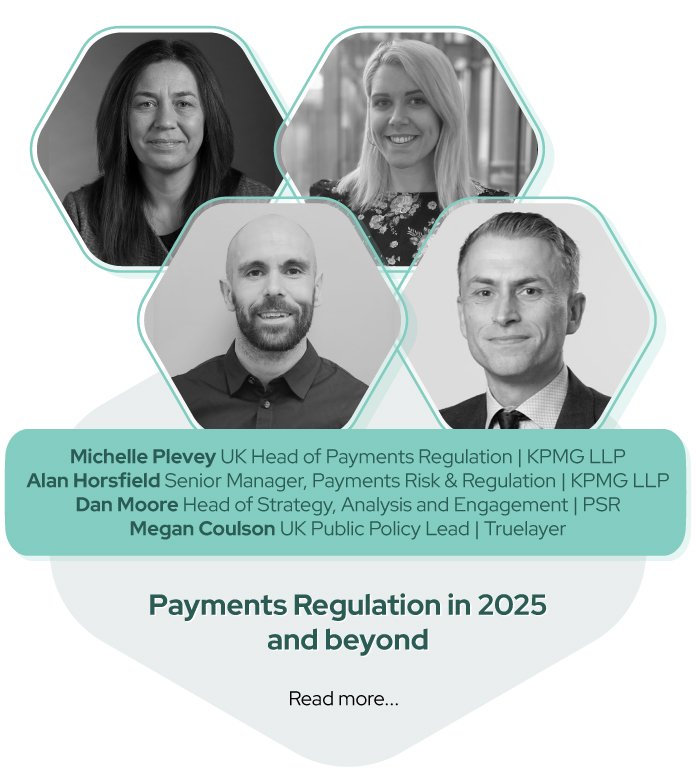
Michelle Plevey BIO:
Michelle is the Director of KPMG’s payments regulatory team, providing advice to a wide variety of payment service providers including Banks, Payment Schemes, FinTechs and EMIs. Her expertise includes Strong Customer Authentication, Regulatory Authorisations and Open Banking.
Alan Horsfield BIO:
A Payments Risk and Regulation consultant with experience helping organisations to understand and achieve compliance with payments regulatory requirements. Alan has advised large global Banks, Corporates and fast-growing Fintechs across issues such as SCA, Open Banking, Merchant Acquiring Authorisation and CHAPs compliance.
Dan Moore BIO:
Dan has been the PSR’s Head of Strategy, Intelligence and Engagement since 2024. He was previously the Director of Rail Strategy and Analysis at the Department for Transport (DfT) and has also worked at the Competition and Markets Authority (CMA), were he led various financial services projects.
Megan Coulson BIO:
Megan is the UK Public Policy Lead at TrueLayer, where she spearheads strategic engagement with policymakers and regulators to advance open banking. Prior to joining TrueLayer, Megan served as an advisor at the FCA, providing insights on the political landscape to senior leadership. She also led financial services policy at the Confederation of British Industry (CBI), with experience in both London and Brussels.
Drawing from over 20 years’ experience in the merchant payments ecosystem, Paul will explore how everyday payments that support ‘buying stuff’ really matter to national and global economies. He will outline where the priorities for payments professionals lie, both in ensuring the payments agenda receives the right priority within merchants’ businesses and give some pointers on how to make sense of the innovations and solutions that compete for their attention.
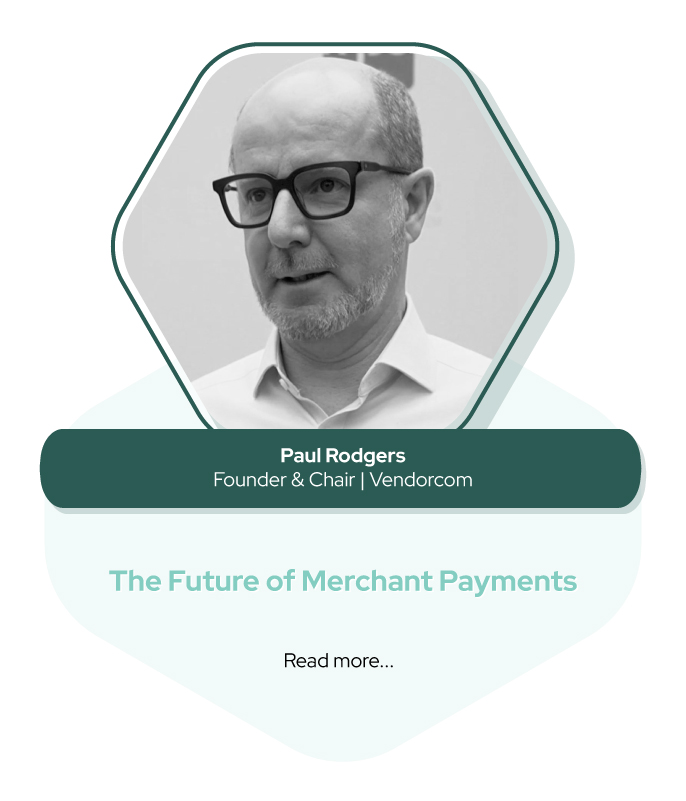
BIO:
Paul is Chair & Founder of merchant payments community, Vendorcom; Evangelist for the World Wide Web Consortium’s Payments Sector in Europe; Mentor at fintech Incubator Level39; former member of the UK Payment Systems Regulator Panel, the UK Financial Conduct Authority’s SCA Monitoring Forum, and the UK Finance SCA PMO Steering Group where he chaired the UK Merchant & Payment Gateway SCA Readiness & Engagement Task Force.
He is passionate about the merchant payments sector and the benefits to be gained by driving innovation through collaboration. His work with Vendorcom ensures that all stakeholders in the merchant payments are connected and have access to authoritative, independent information on strategic and innovative developments, standards, regulation, and market opportunities. Paul is recognised for his broad perspective on industry matters as well as his independence, authority, and pragmatism in dealing with the increasingly complex changes faced by both merchants and solutions suppliers.
Join us to find out:
BIO:
As Director of Global Payment Partnerships at GoCardless, Paul and his team manage global relationships with the organisations that make payments work. His expertise was instrumental in building GoCardless’ ACH payment product, enabling the company to enter the North American market successfully. Paul sits on the UK Finance Working Group on Open Banking and holds the Chartered Banker, MCIBS qualification. The Chartered Banker Diploma is the highest level qualification awarded by the Chartered Banker Institute, recognised and supported by major financial services organisations across the globe.